This month we borrow from our partner Jennifer Graff in Las Vegas, who wrote an excellent post last month about the current state of the real estate market, in response to the Federal Reserve raising interest rates.
And as Jennifer noted, if you were waiting for the part where they hint that this is a one-time thing and relief is coming — that part didn't happen. Sixteen of the eighteen officials on that committee think there's another hike coming this year.
So let's say it plainly, because you're probably not going to hear it said plainly in Metro Detroit any time soon:
Clearer skies aren't ahead.
Builders knew this. Now you do too.
What the increase actually did
Quick clarification, because this gets mangled every single time: the Fed does not set your mortgage rate. Nobody at that table voted on what you'll pay for a thirty-year fixed mortgage.
But mortgage rates had already read the room.
The bond market was already pricing in the possibility of higher-for-longer rates before Wednesday's announcement. And here in Metro Detroit, that matters because a buyer who could comfortably afford a $500,000 house at one rate may qualify for considerably less when the rate moves higher.
What the increase did was remove some of the hope that a dramatic decline in mortgage rates is just around the corner.
Every buyer telling us they're waiting for rates to come down is now waiting on something the Fed has given them very little reason to expect in the immediate future.
Meanwhile, here in Metro Detroit
So while clear skies aren't ahead, maybe it isn't as cloudy around here as the experts think.
The market continues to move. Slowly, sure, but it's moving.
There are still plenty of buyers. Good homes in desirable communities are still selling. Certain price ranges remain extremely competitive.
But the market has changed.
The biggest difference isn't necessarily what homes are worth.
It's what buyers can afford to pay for them.
You're seeing a market that is increasingly divided.
A well-priced, move-in-ready home in a desirable location can still attract multiple buyers.
A home that is overpriced, dated, or sitting in a less desirable location (or all of the above) can sit.
And sit.
Meanwhile, inventory has gradually given buyers more choices than they had as we remerged from the covid shut down.
More houses.
More negotiation.
Higher cost of money.
That's the Metro Detroit market we're dealing with.
If you're selling
There's a gap in this market, and it's the only thing you really need to understand right now.
What sellers want for their house and what buyers are willing and able to pay are two different numbers.
And those numbers have been drifting apart.
You see it all over Metro Detroit.
A seller looks at what the neighbor got six months ago.
Then they add a little more because, after all, their kitchen is nicer.
The house goes on the market.
Nothing happens.
So they reduce the price.
Then they reduce it again.
And eventually they accept an offer that is lower than the one they might have received during the first two weeks — after they've already paid taxes, insurance, utilities, maintenance and mortgage payments for months.
The market doesn't care what you think your house should be worth.
It cares what today's buyer can afford.
And today's buyer is paying attention to the interest rate.
Every time that rate moves higher, the buyer's purchasing power moves lower.
Not metaphorically.
Mechanically.
The pool of people who can comfortably afford your house gets smaller.
And that's particularly important in Metro Detroit because so much of our market sits in the $400,000–$600,000 range where a relatively small change in the monthly payment can materially change a buyer's decision.
The sellers who win for the foreseeable future are the ones who price for the market they're actually in — not the market they remember from 2024.
If you're buying
You have leverage you didn't have a few years ago.
Use it.
You're not necessarily competing against ten other buyers anymore.
You may be competing against two.
Or one.
Or nobody.
Or... build
But here's where it gets particularly interesting if you're looking at new construction.
Because builders don't operate like individual resale sellers.
A resale seller generally has:
Price.
Seller concessions (maybe).
That's about it.
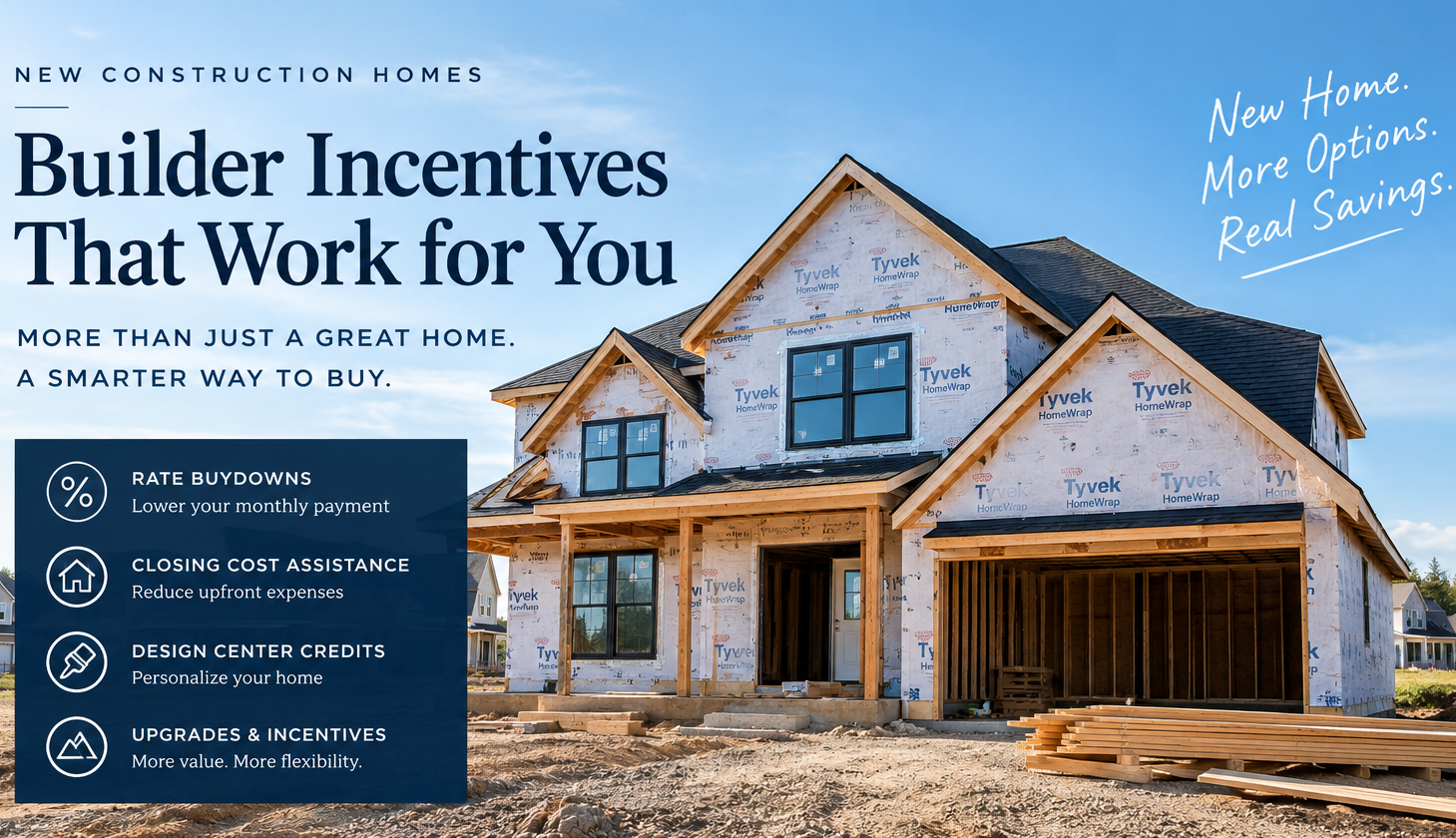
Builders can offer more:
Price.
Rate buy-down.
Closing-cost assistance.
Design-center credits.
Upgrades.
Lot incentives.
And price is often the lever they want to pull last.
Why?
Because cutting the base price can hurt their comparable sales, upset buyers already under contract and establish a lower benchmark for the next house they sell.
So instead, they buy down your mortgage rate.
They pay some of your closing costs.
They throw in upgrades.
They give you money toward the design center.
And suddenly the house that appears to be selling for $650,000 may be a very different deal from the $650,000 resale down the street.
The real deal on a new-construction home often doesn't show up in the advertised sale price.
It shows up in the payment.
And you won't necessarily find it by scrolling through Zillow, Realtor.com or the MLS.
You have to ask.
And this matters even more in Metro Detroit
Builders have spent the last few years adjusting to higher land, labor, material and financing costs.
They're not going to slash prices simply because buyers want them to.
But they will compete.
Especially when they're trying to move inventory.
Especially at the end of a development or phase.
Especially when a builder has completed (spec) homes sitting vacant.
That's why two houses that look similarly priced on paper can have dramatically different economics once you factor in incentives, financing and upgrades.
That's where the negotiation is.
What to do about it
If you're thinking about selling in the next six months, the conversation to have isn't simply:
"What's my house worth?"
The better question is:
"What will my house realistically sell for when I'm ready to put it on the market — and what will I have to do to get it there?"
Those are two very different questions.
If you're buying, the leverage is real.
But it isn't unlimited.
The same higher rates that give you negotiating power with a seller also make your financing more expensive.
And if rates eventually come down significantly, some of today's negotiating power may disappear as more buyers return to the market.
So if you find the right house, don't automatically wait for the perfect rate.
You may be able to negotiate the price today.
You may be able to negotiate seller-paid closing costs.
You may be able to negotiate a rate buy-down.
And with new construction, you may have even more options.
The goal isn't necessarily to buy when rates are lowest.
The goal is to buy when the combination of price, financing and termsmakes sense for you.
That's a very different strategy.
And in Metro Detroit right now, it's the strategy worth paying attention to.
If you're thinking about buying or selling in the next six months, let's talkbefore the market makes the decision for you.
Pictured above: what AI tells us a builder ad should look like.
The owners of The New Home Experts®, have over 45 years of combined experience in real estate, including time with builders like Pulte & Toll Brothers. They also provide market research for area builders, developers, and national firms. If you’re considering a new home, remember: the builders' rep represents the builder, not you. Work with the only local agents in Metro Detroit to specialize in new homes, and save money in the process – ask us how!
Check out this article next